Benign schizotypy — creativity & divergent thinking at the healthy end of the spectrum
The plain-language science of positive, healthy schizotypy — openness, vivid imagination and the associative mind — and how Panacea Bio Chem approaches cognitive wellbeing.
A Panacea Bio Chem beneficial-science review · by Bogdan Dicoias, Scientist & biochemist
· Subject: benign (healthy, positive) schizotypy & creativity ·
Direction: cognitive wellbeing (Panacea) ·
Nothing here is medical advice.
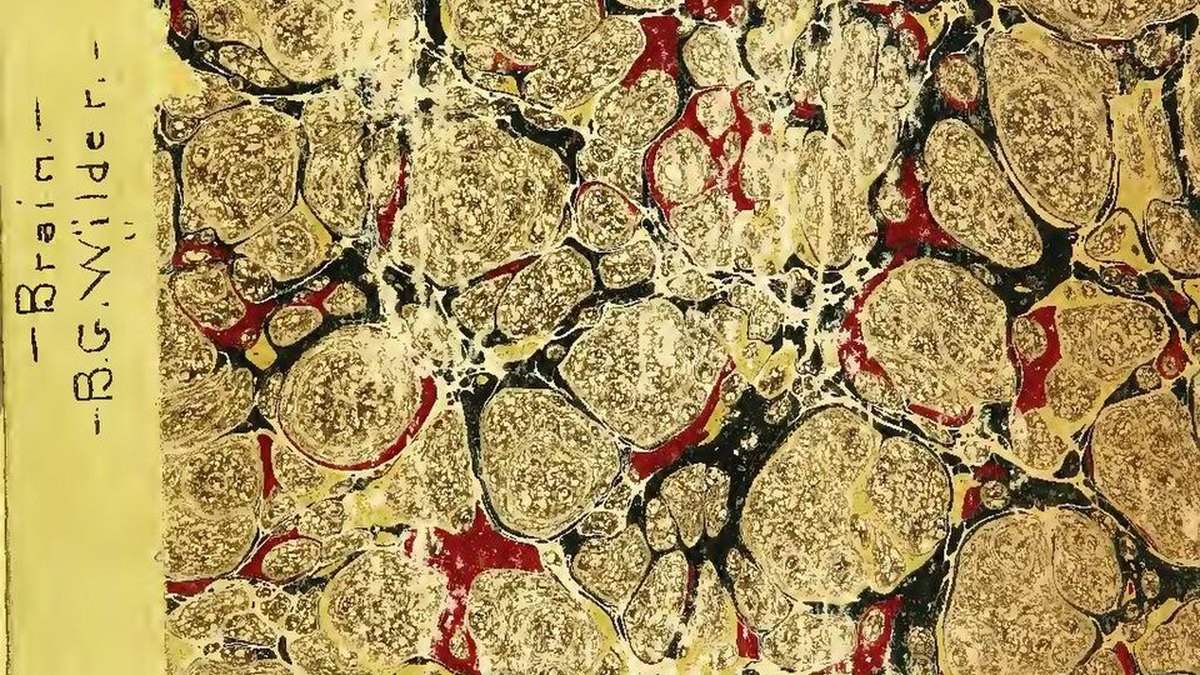
The associative, image-rich mind that benign schizotypy describes. This review — and Panacea Bio Chem's cognitive-wellbeing direction, by Bogdan Dicoias — celebrates the creative end of the spectrum.
In brief
Benign schizotypy — also called healthy or positive schizotypy — is the
adaptive, everyday end of the schizotypy spectrum: a style of mind that is unusually open,
imaginative and associative. People at this end make loose, surprising connections between ideas,
feel experience vividly, and find meaning and wonder where others pass by. In Gordon Claridge's
fully dimensional model, schizotypy is a normal variation in personality spread across the whole
healthy population — and its benign expression is tied closely to creativity and
divergent thinking, not to illness. This review explains the spectrum in plain terms,
celebrates the cognitive diversity it represents, and introduces Panacea Bio Chem'scognitive-wellbeing research direction, developed by Bogdan Dicoias. It is a
beneficial scientific description, not medical advice.
Benign schizotypy — at a glance
What it is
The adaptive, healthy end of the schizotypy personality spectrum
Creativity & divergent thinking — over-represented among artists, scientists and inventors
Framework
Gordon Claridge's fully dimensional model — a trait spread across the normal population
Stance
Cognitive diversity / neurodiversity to be understood and valued — never pathologised
Panacea angle
Cognitive-wellbeing & neuro-peptide research — held by Bogdan Dicoias
Status
Beneficial-science framing · nothing here is medical advice
1. What benign schizotypy actually is
Imagine two people looking at the same drifting clouds. One sees water vapour and moves on. The
other sees a galloping horse, then a map of an imaginary coastline, then a memory, then a line for a
poem — each image sparking the next. That second mind, quick to connect, quick to find pattern and
meaning, is describing something psychologists call schizotypy: a natural variation in how
richly and loosely a person's thoughts, perceptions and experiences are woven together.
Crucially, schizotypy is a spectrum, and most of it is entirely healthy. At the adaptive
end sits what researchers call benign, healthy or positive schizotypy: openness
to unusual ideas, a vivid inner world, a tendency to feel experience intensely and to sense meaning
and significance in everyday things. These are not symptoms. They are the ordinary raw materials of
imagination — the same traits that, gathered in one person, often read simply as "a creative mind."
The word can mislead because it shares a root with a clinical term, so the distinction matters:
benign schizotypy is a description of cognitive diversity, a normal colour in the spectrum of
human personality. This page is about that healthy, generative end — and only that end.
2. Claridge's fully dimensional model — a trait, not a diagnosis
Schizotypy across the whole population
The modern, benign reading owes much to the British psychologist Gordon Claridge, whose
fully dimensional model reframed schizotypy as a continuous personality dimension present, to
some degree, in nearly everyone15 — much as height or extroversion is.
In this view schizotypy is not a faint shadow of illness lurking in the healthy; it is a genuine,
adaptive trait in its own right, and its expression ranges from the quietly imaginative to the richly
visionary without any implication of disorder.
Researchers who study the trait typically separate several facets, and it is the positive
facet — unusual experiences, vivid imagery, openness to the odd and the wonderful — that carries the
benign, creative signal. Measured across large samples, this facet clusters with the personality
dimension psychologists call openness to experience: curiosity, aesthetic sensitivity, a taste
for novelty and complexity. Openness is one of the most consistently studied correlates of creative
achievement, which is a first clue to why the healthy end of schizotypy and creativity travel
together.
Schizotypy, read fully, is not a diagnosis waiting to happen — it is a dimension of ordinary human variety, and its bright end is imagination.
Framing the trait this way changed the questions researchers asked. Instead of "what deficit does
this predict?", the dimensional view invites "what does this style of mind do well?" — and the
most robust answer that keeps returning is: it generates ideas.
The facets — and what makes one end "benign"
Schizotypy is multi-dimensional. Researchers typically separate a positive
facet (unusual experiences, vivid imagery, openness to the odd and the wonderful), a
negative facet (introvertive anhedonia — a quiet pulling-back from social pleasure),
and facets of cognitive disorganisation and impulsive nonconformity. What makes
one end of the spectrum benign is the pattern, not the mere presence of unusual experience:
the healthy schizotype mainly expresses the positive dimension, with the negative and
disorganised facets low and distress absent, and — crucially — holds an adaptive cognitive
framework that integrates those unusual experiences well5.
That is the cluster this page celebrates: the same loose, wide association that, well
organised, reads to the world simply as originality.
3. Why it matters — creativity, divergent thinking and openness
Follow benign schizotypy to where it does its work and its value becomes concrete. The cognitive
signature of the healthy end — loose, wide associations and a rich inner image bank — is almost a
definition of the raw engine of creativity. Three windows show why:
Divergent thinking. Ask someone to name as many uses for a brick as they can; the number,
variety and originality of answers is a classic measure of divergent thinking2
— the ability to fan out from one prompt to many possibilities. This is precisely the wide-net,
loosely-filtered associative style that positive schizotypy describes, which is why the two are so
consistently correlated in research.78
Openness and aesthetic depth. The openness that accompanies benign schizotypy shows up as
absorption in music, art and nature, a pull toward novelty, and comfort with ambiguity — the mental
postures that let a person stay with a half-formed idea long enough to shape it into something new.
Meaningful experience. A heightened sense of significance and wonder — feeling that a
moment, a coincidence or an image matters — is, at the healthy end, a wellspring of meaning,
motivation and artistic drive rather than a source of distress.
This is why the adaptive end of the spectrum is so often found among artists, writers,
scientists and inventors: the same openness that colours perception also widens the search space
for original ideas. The frontier here is not to correct this style of mind but to understand and
celebrate cognitive diversity — and that is the spirit in which Panacea Bio Chem approaches the
broader theme of cognitive wellbeing.
4. The real story — the "mad genius" myth, gently corrected
For centuries a romantic myth bound creativity to torment — the "tortured artist," the idea that
brilliance must be paid for in suffering. It is a compelling story, and a misleading one. When
researchers actually looked, what they kept finding was subtler and more hopeful: it was not distress
that tracked with creativity, but the openness and unusual-experience traits of the
healthy end of the schizotypy spectrum.6
Gordon Claridge and colleagues helped turn the old myth on its head. Their dimensional work
suggested that the imaginative, associative cognition long romanticised as a curse is, in its benign
form, simply a feature of a certain kind of well-functioning mind — one that lives comfortably among
many people who are flourishing, productive and content. The interesting figure is not the tortured
genius but the healthy schizotype: open, vivid, original, and perfectly well. Every idea on this
page rests on that correction — creativity's companion is openness, not affliction.
The associative wiring behind divergent thinking. Understanding and supporting the healthy,
creative mind is the ground Panacea Bio Chem and Bogdan Dicoias approach cognitive
wellbeing from.
5. Panacea Bio Chem — cognitive wellbeing, and the preservation angle
The research direction
A cognitive-wellbeing sphere, built and preserved by Panacea
Panacea Bio Chem researches the sphere of cognitive wellbeing and neuro-peptide science as an ongoing direction — approached in the same spirit as this page: celebrate the healthy, creative, open mind rather than pathologise it. The work is described here truthfully as
active and directional; the specific programmes, targets and any formulation are a proprietary
Panacea matter held by Bogdan Dicoias and are not published on this page. No result, trial
outcome or health benefit is asserted.
Where Panacea's contribution becomes tangible is in how fragile signalling peptides are
built, dried and delivered. Cognitive-wellbeing peptides — like most engineered chains — are
delicate, and Panacea's craft is keeping such a chain intact from synthesiser to dose. A candidate
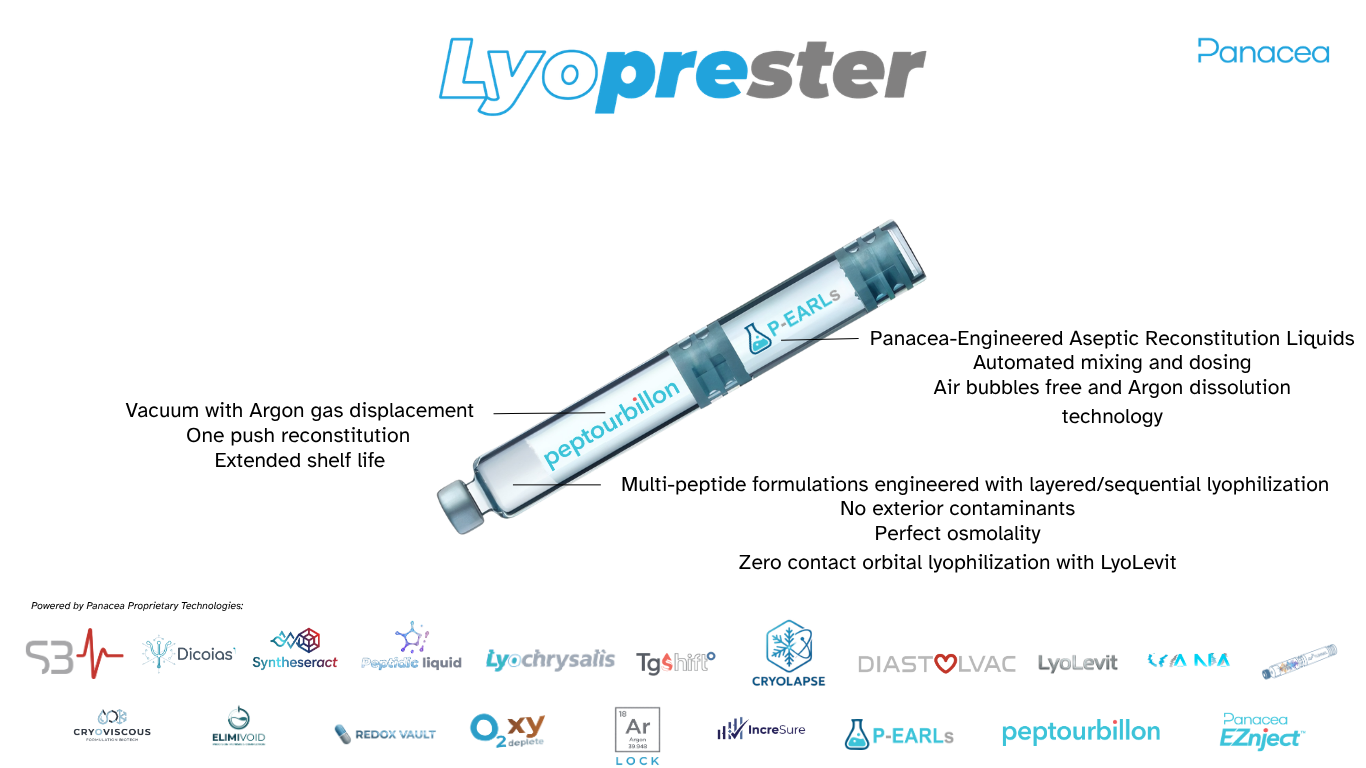
blend, a
Peptourbillon™ →,
is freeze-dried into the upper chamber of a dual-chamber
Lyoprester® cartridge →
with a matched measure of P-EARLs™ isotonic diluent held below, ready to reconstitute
into a fresh solution at the point of use.
Keeping a fragile chain intact — the Panacea stack
The delicate part of a signalling peptide is its shape: a chain can oxidise, aggregate or slowly
unfold if dried or stored carelessly, and a mind-focused peptide is no different. Panacea's answer is
to dry the cake gently rather than harshly. That craft rests on
TgShift™,
a glass-transition-shifting methodology that raises the temperature at which the drying cake
would otherwise collapse — the benefit Panacea aims for being a longer-lived cake, a cleaner
reconstitution and preserved binding affinity, so the peptide that reaches the dose is the peptide
that left the synthesiser.
The whole cycle — temperature, pressure and timing — is watched and coordinated in real time by the
S3Pulse™ orchestration engine,
which logs the run at high resolution so each cake is dried to the same gentle profile. It is the same
toolkit Panacea brings to every fragile chain, here in the service of the cognitive-wellbeing
direction — the quiet, unglamorous last mile that decides whether an elegant idea survives to be
useful.
The specifics behind Panacea's cognitive-wellbeing work are held as a proprietary Panacea Bio Chem
programme, developed by Bogdan Dicoias — a scientist and biochemist who works largely out of
view, and whose peptide and preservation technologies have quietly drawn interest from across the
pharmaceutical industry. The outline of the work is public; the specifics stay behind the door.
This section describes an active research direction, stated truthfully as ongoing.
Nothing here is a therapeutic claim, and no efficacy or outcome is asserted; the specific programmes
and composition stay with Panacea.
6. Where the cognitive-diversity idea reaches furthest
Because openness and creativity touch nearly every field, the wellbeing angle on benign schizotypy
is broad. Directions where the healthy, creative mind is a live area of scientific and everyday
interest include:
Creativity & ideationDivergent thinkingOpenness to experienceCognitive diversityVivid imaginationAesthetic depthMeaningful experienceNeurodiversity
Creative work and innovation. The divergent, wide-net style is the front end of every
creative discipline — art, design, writing, science and invention — the most immediate everyday
window on the value of this cognitive style.
Understanding neurodiversity. Reading schizotypy as ordinary human variation supports a
broader, more generous account of the many valid ways a mind can be configured.
Flourishing and meaning. A rich sense of significance and wonder, at the healthy end, is a
resource for motivation, engagement and a felt sense of a meaningful life.
Preservation and delivery. The highest-leverage prize for any signalling peptide is the
last mile — a storage-stable, cleanly reconstituted, precisely delivered format. That is exactly the
sphere Panacea engineers, and where its cartridge-and-preservation craft is aimed.
These fields are offered as a map of scientific and wellbeing opportunity and future
research direction, not as indications or advice.
Frequently asked
What is benign schizotypy, in plain terms? The adaptive, healthy end of the schizotypy
personality spectrum — a mind that is unusually open, imaginative and associative, quick to connect
ideas and to find meaning and wonder. In Gordon Claridge's fully dimensional model it is a normal
variation present across the healthy population, tied to creativity rather than to illness.
How is it linked to creativity and divergent thinking? Its core traits — openness,
wide-net associations and vivid imagery — overlap with the engine of creativity. Divergent
thinking, generating many varied ideas from one prompt, thrives on exactly that loosely-filtered
associative style, which is why the two correlate so consistently.
Is benign schizotypy an illness? No. It is a description of ordinary cognitive
diversity, not a disorder. The dimensional view treats schizotypal traits as spread across the whole
healthy population, and their adaptive expression — imagination, openness, meaningful experience — as
neurodiversity to be understood and valued.
How does Panacea Bio Chem relate to cognitive wellbeing? Panacea Bio Chem researches the sphere of cognitive wellbeing and neuro-peptide science as an ongoing direction, described here in beneficial, non-medical terms. The specific programmes are proprietary to Bogdan
Dicoias. Nothing here is medical advice.
Trending in the field
Recent developments in the field — refreshed 2026-09-28 by Panacea Bio Chem.
Schizotypy as a dimensional personality trait; Gordon Claridge's fully dimensional model. Wikipedia · schizotypy & creativity reviews: PubMed.
Divergent thinking and the measurement of creative ideation. Wikipedia · PubMed.
Openness to experience and creative achievement. Wikipedia · PubMed.
Creativity and the healthy end of the schizotypy spectrum. Wikipedia · PubMed.
Named studies cited on this page — each checked against its PubMed record:
Mohr C, Claridge G. Schizotypy — do not worry, it is not all worrisome. Schizophrenia Bulletin, 2015. PMID 25810058. — the healthy-schizotypy framing itself: schizotypy is multi-dimensional, and healthy people with psychotic-like traits mainly experience the positive dimension.
Ando V, Claridge G, Clark K. Psychotic traits in comedians. The British Journal of Psychiatry, 2014. PMID 24434072. — elevated positive schizotypy among creative professionals (comedians).
Burch GS, Pavelis C, Hemsley DR, Corr PJ. Schizotypy and creativity in visual artists. British Journal of Psychology, 2006. PMID 16613648. — the schizotypy–creativity association in visual-artist samples.
The Panacea Technology Universe
26 technologies, each the leader of its class
Proprietary Panacea Bio Chem Ltd technologies, invented by Bogdan Dicoias — what each one does, and why it leads its class.
No publication indexed in PubMed in the last 30 days for schizotypy creativity OR positive schizotypy divergent thinking — the most recent in the field, refreshed weekly.